Research

LLMs for Editing

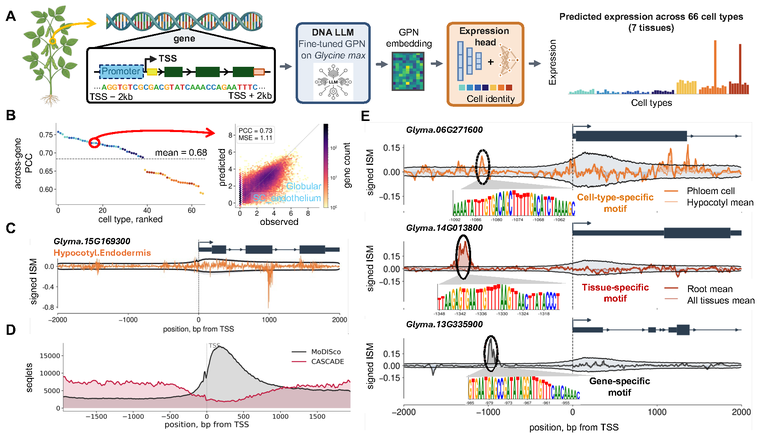
We are building language-model approaches that help connect DNA edits to gene function and plant performance. By learning the causal impact of genetic changes, these models can guide the design of crops with greater climate resiliency, improved efficiency, and sustainable production pathways for the future bioeconomy.

CASCADE: DNA language-model attributions resolved across 66 soybean cell types, recovering promoter-associated regulatory motifs

Mechanistic Ag AI

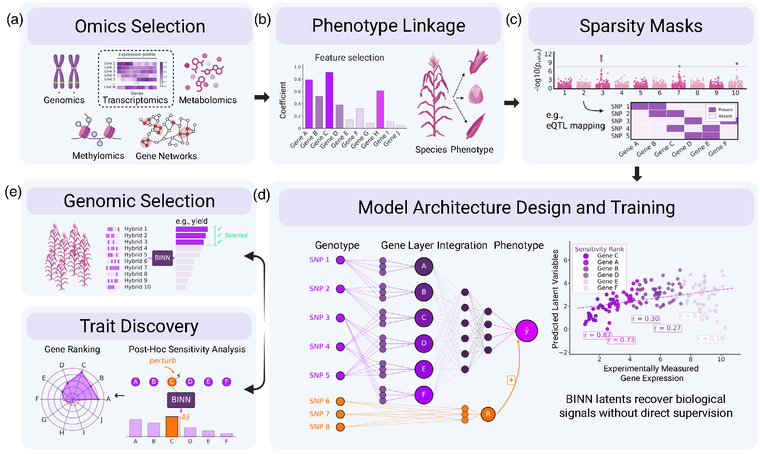
Modeling from DNA sequence to performance across environments is a high-dimensional, nonlinear learning problem. Off-the-shelf AI alone is not enough. We build gray-box models that combine domain knowledge with data-driven learning to improve sample efficiency and deliver interpretable insights.

Biology-informed neural networks embedding omics structure for genomic prediction and trait discovery

Active Learning for Ag

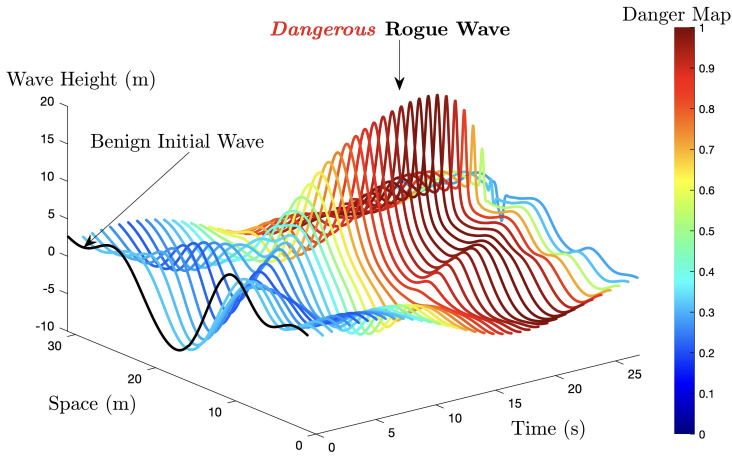
Agriculture advances in yearly cycles, yet genetic gain must accelerate to meet growing global demand. We translate ideas from Bayesian experimental design and optimization into the agriculture context to prioritize the most informative experiments and speed discovery.

Active learning in deep neural operators discovering and forecasting extreme events

Agents for Ag Design

Agricultural design spans billions of base pairs, multiple phenotypes, complex environments, and economic constraints. No single model solves it all. We build agentic workflows that explore more options, navigate trade-offs, and move decisions forward faster while keeping insights transparent and actionable.

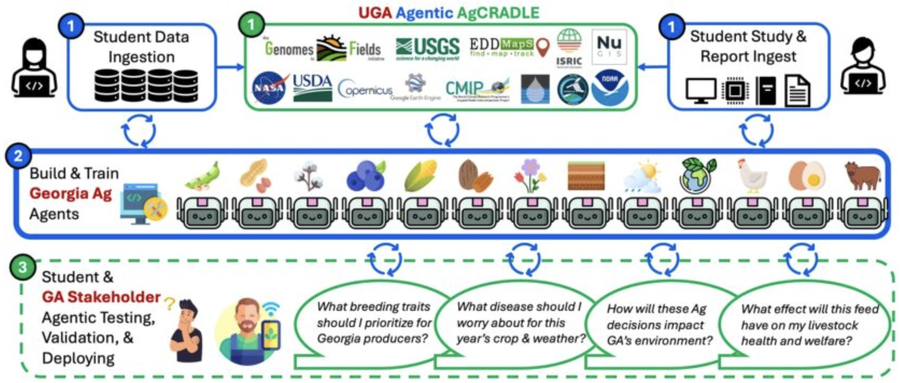
We also teach it. Ethan co-leads AI Agents for a Sustainable Food Supply, a UGA VIPR team run with Scott Jackson, in which undergraduates work alongside mentors to design, test, and refine interactive agents that support breeding decisions and crop production advice — building real competency in agentic AI, data science, and food systems along the way.
UGA Agentic AgCRADLE: students ingest open agricultural data and study reports, use them to build and train Georgia crop and livestock agents, then test, validate and deploy those agents against real grower questions